Opinion
Good Roads Can Help Fight Insecurity, but Nigeria Cannot Asphalt Its Way to Peace
Better roads can help security forces respond faster, reconnect isolated communities and support local economies. But Nigeria should be careful not to mistake infrastructure development for a complete security strategy.
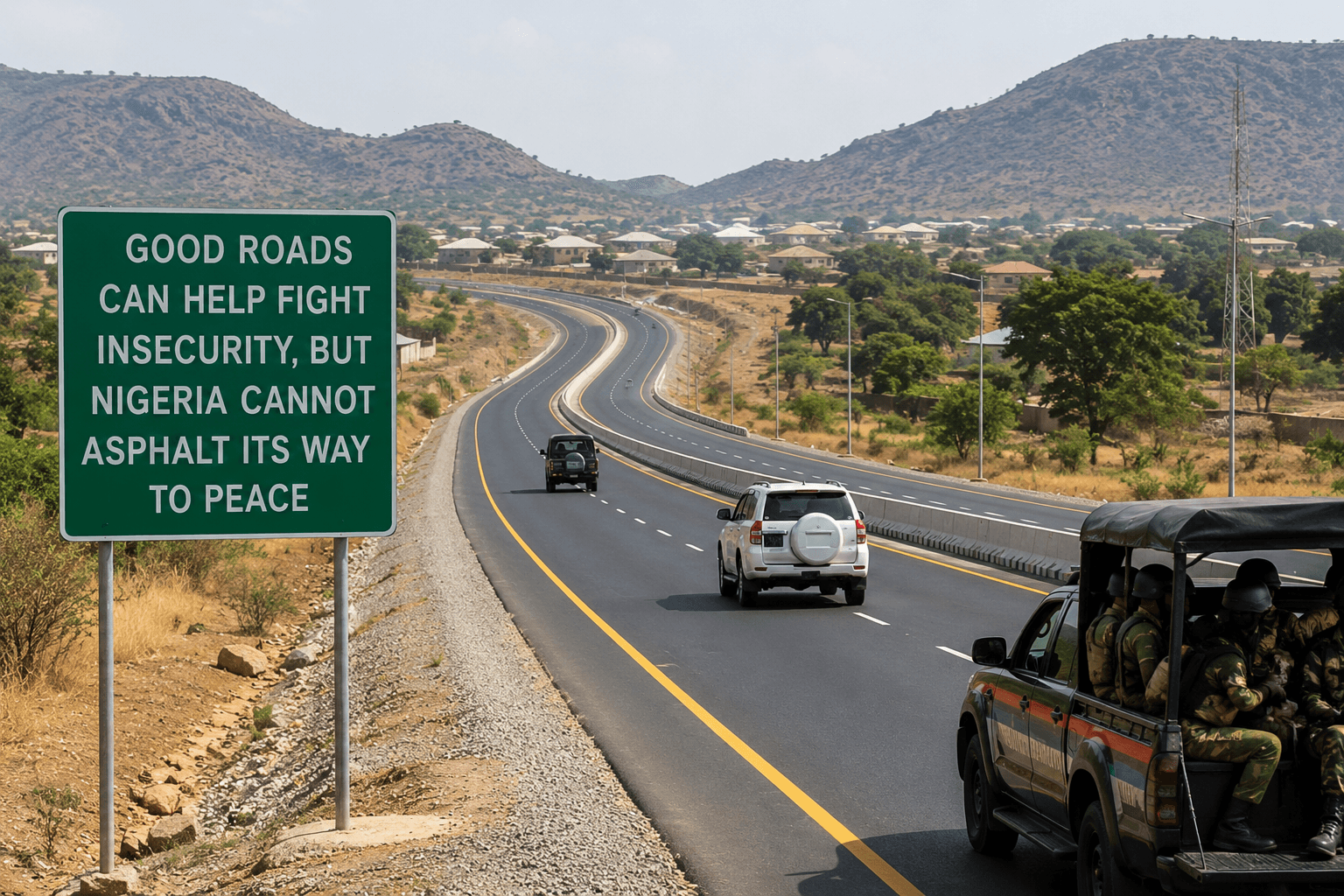
There is truth in the argument that better roads can help Nigeria fight insecurity.
A soldier cannot respond quickly to an attack if the road is nearly impossible to travel.
An ambulance cannot save lives if it takes hours to reach a community.
Farmers cannot move their produce safely if roads are abandoned and criminals control the surrounding routes.
Police officers cannot patrol effectively when some communities are difficult to reach.
So when Nigeria's Minister of Works, David Umahi, argues that strategic road projects can contribute to the fight against insecurity, the idea deserves serious consideration.
But it also deserves an important qualification.
Nigeria cannot asphalt its way to peace.
A good road can help security forces reach a community faster. It cannot replace intelligence.
A bridge can connect two towns. It cannot create trust between residents and security agencies.
A highway can increase economic activity. It cannot prosecute kidnappers, stop the financing of armed groups or resolve a land conflict.
Infrastructure is part of security.
It is not a substitute for security.
A Road Can Be a Security Asset
Nigeria's insecurity is often discussed in terms of weapons, soldiers, police officers and military operations.
But geography matters too.
Many attacks happen in rural areas where communities are scattered across large distances. Poor roads can slow emergency responses and make it difficult for security forces to maintain a regular presence.
In that context, a functioning road is not merely a development project.
It can become part of the security architecture.
The argument is particularly relevant in Borno State, where communities have endured years of insurgency and where the government is investing in strategic road corridors.
Better transport links can make it easier to move security personnel and humanitarian supplies. They can also reconnect communities with markets, hospitals and government services.
The economic effect matters because isolation can deepen poverty and weaken the relationship between citizens and the state.
A road can tell an isolated community: you have not been forgotten.
But only if the road is safe enough to use.
Who Controls the Road After It Is Built?
This is the question Nigeria must ask.
Building a road through an insecure area is one achievement.
Keeping that road safe is another.
Nigeria already has highways where travellers calculate what time they can safely begin a journey. There are roads people avoid because of kidnapping. There are communities where movement becomes dangerous after certain hours.
A newly constructed road can improve military mobility.
But the same road can also improve mobility for criminals if the state does not maintain security along it.
That is why infrastructure and security planning must happen together.
Where are the vulnerable sections of a new road?
How quickly can security forces respond to an incident?
Are there functioning communication networks along the corridor?
Do surrounding communities have trusted ways of reporting suspicious movements?
Are security personnel regularly present, or do they arrive only after an attack?
These questions should be part of infrastructure planning from the beginning.
A road should not be considered complete simply because contractors have left the site.
Its success should also be measured by whether ordinary people can travel on it without fear.
Insecurity Is More Than a Mobility Problem
Nigeria must also resist the temptation to search for one simple explanation for a complicated crisis.
The country's security problems are not all the same.
Insurgency in the northeast is different from kidnapping for ransom.
Farmer-herder violence has different dynamics from oil theft.
Communal disputes are not identical to organised banditry.
Urban crime requires different responses from attacks on remote villages.
Roads can support responses to many of these problems, but they cannot explain or solve all of them.
Some security problems require better intelligence.
Some require functioning courts.
Some require policing reform.
Some require control of illegal weapons.
Some require action against criminal financing.
Others require local mediation before disputes become violent.
Nigeria's security crisis has many roots. The solution will also require many tools.
Development Can Reduce the Space in Which Insecurity Grows
There is, however, a deeper reason infrastructure matters.
Insecurity does not exist separately from economic life.
When a road connects farmers to markets, agriculture becomes more viable.
When businesses can transport goods, commercial activity grows.
When a young person can travel to work or access a larger market, opportunity expands.
When teachers and healthcare workers can reach rural communities more easily, the state becomes more visible in people's lives.
These things do not automatically end violence.
But development can reduce isolation and expand legitimate economic opportunities.
That is important because armed groups and criminal networks often operate more easily in places where government presence is weak and opportunity is scarce.
The relationship between development and security is therefore real.
But we should be precise about it.
A road does not defeat a terrorist.
A road creates conditions that can help the state protect people, deliver services and support economic life.
The difference matters.
Nigeria Has Too Many Projects That Exist More Strongly in Speeches Than in Communities
There is another reason for caution.
Nigerians have heard many promises about infrastructure.
Roads are announced.
Budgets are approved.
Ceremonies are held.
Politicians make speeches.
Then citizens wait.
Sometimes for years.
A serious infrastructure-for-security strategy must therefore be judged by delivery rather than announcement.
Is the road actually completed?
Is it built to a standard that will survive?
Is maintenance funded?
Can communities use it throughout the year?
Has travel time genuinely fallen?
Has commercial activity improved?
And most importantly for the security argument: do people feel safer using it?
Those are better measures of success than the number of kilometres announced at a political event.
Security Must Be Built With Communities, Not Only Around Them
Nigeria's security debate often treats local communities as people who need to be protected but not people who need to be heard.
That is a mistake.
The farmer knows which paths are being used at unusual hours.
The trader knows when movement suddenly disappears from a market.
The driver knows which sections of a highway have become dangerous.
The traditional leader may understand a local dispute before it becomes violent.
The young people in a village often know when unfamiliar armed men begin moving through an area.
This knowledge matters.
Better roads can help the state enter communities, but trust determines whether information flows in the other direction.
Nigeria needs both.
Infrastructure without trust may create access but not intelligence.
Security forces need relationships with the communities they protect, and those communities need confidence that sharing information will not expose them to retaliation or abuse.
The State Must Arrive With More Than Soldiers
In many neglected communities, citizens encounter the government mainly during elections, military operations or after tragedy.
That is not enough.
A functioning state should also arrive as a school.
A health centre.
A road.
Electricity.
Clean water.
Agricultural support.
A functioning local authority.
A police station people trust.
When government presence is reduced only to armed response, citizens experience the state mainly as a force reacting to crisis.
Infrastructure can help change that relationship.
This is where the argument connecting roads and security becomes strongest.
The value of a road is not merely that an armoured vehicle can travel on it.
Its greater value may be that a teacher, nurse, farmer, trader and police officer can all use it.
Security is not only the absence of gunfire.
It is also the presence of functioning society.
Roads Must Serve the People Who Live Along Them
Major infrastructure projects often focus on movement between cities, borders and commercial centres.
That matters.
But Nigeria should also think about the communities beside these roads.
A highway passing through a poor community is not automatically development for that community.
Can local farmers access the road?
Are there feeder roads connecting villages?
Can local businesses benefit from increased movement?
Are young people in the area gaining legitimate opportunities?
Are residents protected from displacement and unfair treatment during construction?
If infrastructure is meant to support peace, local people must see themselves as beneficiaries rather than spectators.
Development that passes through a community without improving life there can create resentment instead of stability.
Nigeria Needs a Complete Strategy, Not a Convenient Slogan
The government should continue building roads.
Nigeria desperately needs better infrastructure.
Strategic roads in conflict-affected areas can improve military logistics, reconnect communities, expand trade and strengthen government presence.
All of that is valuable.
But Nigerians should be careful whenever one policy is presented as though it can carry the entire weight of a national crisis.
Roads are not intelligence officers.
Bridges are not courts.
Highways cannot investigate ransom networks.
Asphalt cannot create trust.
Nigeria's insecurity requires competent policing, military effectiveness, intelligence gathering, functioning justice, border security, local cooperation and economic opportunity.
Infrastructure can strengthen all of these efforts.
It cannot replace them.
The real question is therefore not whether roads can help fight insecurity.
They can.
The real question is whether Nigeria can combine infrastructure with the institutions, people and policies required to make security last.
Build the roads. But build the intelligence networks too.
Build the bridges. But rebuild trust between communities and the state.
Connect the towns. But make sure the people travelling between them are safe.
Because a beautiful road that citizens are afraid to use is not evidence that insecurity has been defeated.
It is only a faster route through an unsafe country.
This article represents the editorial opinion of Talk Ya True.
Stay Informed
Get the biggest stories from Nigeria, Africa and around the world.
Free news updates. Unsubscribe anytime.
By subscribing, you agree to receive free news updates from Talk Ya True. You can unsubscribe at any time.