Africa
South Africa’s New Cabinet Appointments Spark Race Debate as Predominantly White DA Team Takes Key Government Posts
President Cyril Ramaphosa’s latest changes to South Africa’s national executive have triggered a heated debate about race, transformation and political representation after a predominantly white group of Democratic Alliance politicians was appointed or moved into key government positions. In a country where apartheid ended only three decades ago and racial inequality remains deeply visible, the appointments raise a difficult question: should Cabinet representation reflect the country’s demographics, or should political parties be free to choose officials primarily on experience and party strategy?
South Africa’s latest Cabinet reshuffle has reopened one of the most sensitive debates in the country’s democracy.
Race.
Representation.
Power.
And who gets to occupy the highest offices of the state.
President Cyril Ramaphosa announced changes to the national executive following consultations with the Democratic Alliance, South Africa’s second-largest political party and a major member of the Government of National Unity.
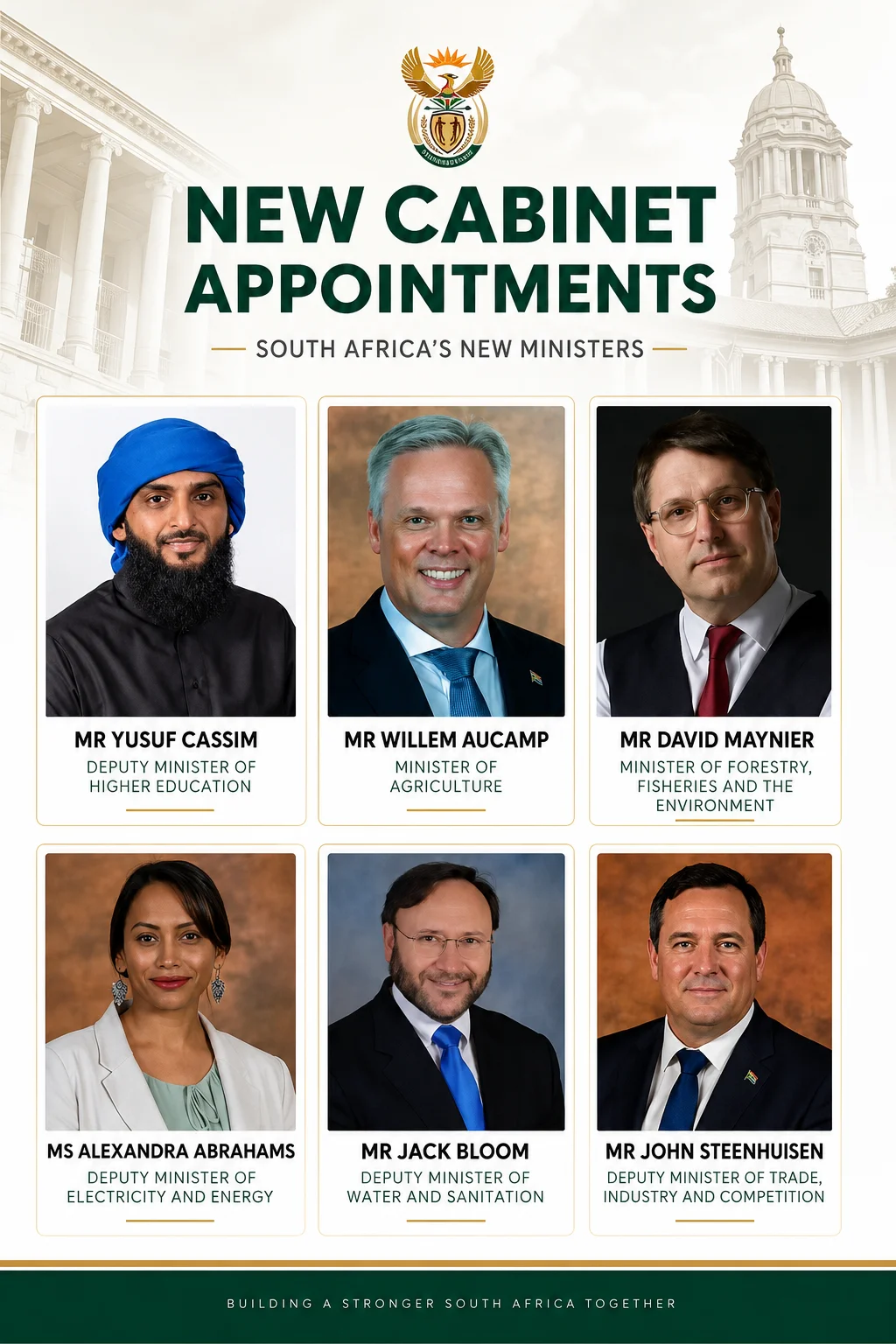
The changes placed Willem Aucamp in Agriculture, David Maynier in Forestry, Fisheries and the Environment, John Steenhuisen as Deputy Minister of Trade, Industry and Competition, Alexandra Abrahams as Deputy Minister of Electricity and Energy, Jack Bloom as Deputy Minister of Water and Sanitation, and Yusuf Cassim as Deputy Minister of Higher Education.
On paper, these are political appointments resulting from negotiations inside a coalition government.
But in South Africa, the racial composition of political power is never just a matter of appearance.
A predominantly white slate of appointments from the DA has inevitably revived arguments about whether the country’s institutions are becoming genuinely representative—or whether the changing balance of power inside the GNU is giving disproportionate influence to a party that has long struggled with perceptions about its racial identity.
The controversy is uncomfortable.
But South Africa cannot avoid it.
The Photograph Became Part of the Political Story
In modern politics, images can become arguments before politicians have even spoken.
For many South Africans reacting to the reshuffle, the composition of the group attracted immediate attention.
The question was simple:
Does this group reflect South Africa?
The country’s population is overwhelmingly Black African, while white South Africans constitute a minority.
That does not mean white citizens should be excluded from government.
They are South Africans.
They have the same democratic rights to vote, contest elections and hold public office.
But representation becomes politically sensitive when several appointments arrive together and appear to underline the longstanding criticism that the DA has struggled to build a leadership image reflecting the racial diversity of the country it wants to govern.
The DA has faced this perception for years.
Its defenders argue that reducing political appointments to race is itself dangerous and that competence, experience and electoral mandate should matter more than skin colour.
Its critics respond that in a country shaped by centuries of racial exclusion, pretending race no longer matters is equally dangerous.
Both arguments collide in this reshuffle.
Six DA Figures, Powerful Areas of Government
The appointments affect important parts of the South African state.
Agriculture is central to food security, exports and the rural economy.
Forestry, fisheries and environmental policy involve natural resources, conservation and climate policy.
Trade and industry influence investment, manufacturing and job creation.
Electricity remains one of South Africa’s most important economic challenges.
Water security is becoming increasingly urgent.
Higher education shapes the future of millions of young South Africans.
These are not ceremonial appointments.
They involve institutions that influence the country’s economic future.
The DA said its changes were designed to strengthen its contribution to government and improve performance. In announcing its proposed changes before Ramaphosa formally acted, the party presented the appointments as a question of accountability, competence and effective delivery.
But critics of the racial composition are asking a different question.
Can competence and representation really be separated so easily in South Africa?
South Africa Cannot Discuss Power Without Discussing Apartheid
To understand why the appointments are controversial, outsiders must understand South Africa’s history.
Apartheid was not simply a system of social prejudice.
It was a system of political and economic power.
Race determined where people could live.
Where they could work.
What education they could receive.
What land they could own.
Whether they could vote.
And who controlled the state.
When democratic rule arrived in 1994, political transformation was therefore never expected to mean only changing the president.
It was also about transforming institutions.
The civil service.
The police.
The military.
State companies.
Universities.
Corporate leadership.
Land ownership.
And access to economic opportunity.
More than three decades later, South Africa remains one of the world’s most unequal societies.
That is why the racial composition of government appointments still attracts scrutiny.
For many Black South Africans, representation is not cosmetic.
It is connected to a historical struggle for access to institutions from which the majority was deliberately excluded.
But Should White South Africans Be Made to Feel Like Outsiders?
There is another side to the argument.
Democracy cannot correct historical racial exclusion by creating a new principle that some citizens are permanently less entitled to public office because of their race.
White South Africans are citizens of the country.
Many were born after apartheid ended.
They vote.
They pay taxes.
They join political parties.
They stand for election.
And under a constitutional democracy, they have the right to serve in government.
The real debate should therefore not be whether a white South African can become a minister.
Of course they can.
The more difficult question is whether a political party seeking national power can build a leadership pipeline that is broadly representative of the society it hopes to govern.
One white minister is not a racial crisis.
Five white politicians in a wider set of changes are not automatically evidence of racism.
But when a predominantly white cluster of appointments emerges from a party already fighting perceptions about racial representation, public scrutiny is predictable.
The DA should be prepared to answer that scrutiny rather than dismiss it.
The DA Says the Changes Are About Performance
The DA’s own explanation is straightforward.
The party says its revised GNU team is intended to improve its contribution to government.
It has highlighted the records and expected responsibilities of its appointees, arguing that its representatives should demonstrate accountability, high standards of public service and effective delivery.
That argument will appeal to South Africans frustrated by corruption, unemployment, failing municipalities, electricity problems and weak public services.
Many citizens are tired of symbolic politics.
They want water from their taps.
Electricity in their homes.
Jobs.
Safe streets.
Working hospitals.
Good schools.
A growing economy.
From that perspective, the argument is simple: judge ministers by performance.
But the counterargument is equally powerful.
In a country with South Africa’s history, competence should not be presented as though it belongs to one racial group.
South Africa has millions of qualified Black professionals.
It has experienced public servants, economists, engineers, lawyers, academics and political leaders from every community.
A political party that repeatedly struggles to present diverse leadership cannot simply say it is choosing the “best people” without facing questions about how it defines and discovers talent.
The Real Problem May Be the DA’s Leadership Pipeline
The most serious question may not concern the individual appointees at all.
It may concern the structure of the party producing them.
Political parties do not suddenly search the entire population when a Cabinet position becomes available.
They usually select from their own senior ranks.
That means the diversity of government appointments often reflects the diversity—or lack of diversity—inside party leadership structures.
If a party’s senior leadership pipeline is predominantly drawn from one racial community, its Cabinet nominations may naturally reproduce that pattern.
This is why the DA’s racial challenge cannot be solved only through public relations.
The party must ask whether Black leaders see genuine long-term opportunities inside its structures.
Can they rise?
Can they lead?
Can they disagree?
Can they build independent political identities?
Can they remain influential without being viewed as symbolic proof of diversity?
These questions have followed the party for years.
The latest appointments bring them back.
The GNU Has Changed South African Politics
The controversy also reflects a much larger political transformation.
For decades, the African National Congress dominated national government.
That changed after the 2024 election, when the ANC lost its parliamentary majority and entered a Government of National Unity involving the DA and other parties. The original GNU Cabinet gave the DA six of 32 ministerial posts, alongside other positions held by smaller coalition partners.
That changed the meaning of political power in South Africa.
The DA was no longer only criticising government.
It was inside government.
Its politicians gained responsibility for national departments.
Its internal leadership decisions began affecting the composition of the national executive.
The latest reshuffle is therefore part of the new reality of coalition politics.
Ramaphosa remains president.
But the ANC no longer exercises power in the same way it once did.
Coalition partners now influence who enters government.
And that means internal decisions made by the DA can become national controversies.
Representation Is More Than Skin Colour
There is also a danger in reducing every political debate to visual racial counting.
A Black politician does not automatically represent the interests of poor Black citizens.
A white politician does not automatically govern only for white citizens.
Race matters in South Africa.
But policy matters too.
Who benefits from agricultural policy?
Who receives access to land and financing?
Who benefits from industrial development?
Which communities receive reliable water?
Who gets access to university?
Who receives electricity infrastructure?
Which businesses win opportunities?
Those questions may ultimately tell South Africans more about transformation than photographs alone.
A government can appear diverse while preserving deep inequality.
A politician from a historically disadvantaged community can still support policies that fail the poor.
A white minister can implement policies that improve the lives of millions of Black citizens.
The test must therefore involve both representation and results.
South Africa should be capable of discussing both at the same time.
The Danger of Racial Politics Going Too Far
South Africa’s political leaders must handle the debate carefully.
Race is real.
History is real.
Inequality is real.
But reckless racial rhetoric can become destructive.
White citizens should not be treated as foreigners in their own country.
Black citizens should not be told to forget structural inequality because apartheid formally ended in 1994.
Neither approach will build a stable democracy.
The responsibility of political leadership is to create a country where every citizen belongs while recognising that historical injustice continues to shape present-day opportunity.
That balance is difficult.
But slogans will not solve it.
Why Yusuf Cassim’s Presence Should Not Be Misrepresented
The list of DA appointments also includes Yusuf Cassim as Deputy Minister of Higher Education.
His presence has sometimes been folded into simplistic online descriptions of the reshuffle based on appearance or assumed ancestry.
That is irresponsible.
A person’s ethnicity should not be assigned based on a name or photograph.
The factual political question is clear enough without speculation: the reshuffle has produced a predominantly white group of DA appointments and transfers, and that composition has renewed debate about racial representation.
The article does not need to invent anyone’s ethnicity to make that point.
The New Ministers Will Ultimately Be Judged by What They Do
The racial debate will continue.
But the appointees now have departments to help lead.
Willem Aucamp enters Agriculture at a time when the sector faces major challenges, including pressure linked to foot-and-mouth disease.
David Maynier takes responsibility for Forestry, Fisheries and the Environment.
John Steenhuisen moves from Agriculture to a deputy role in Trade, Industry and Competition.
Alexandra Abrahams moves to Electricity and Energy.
Jack Bloom enters Water and Sanitation.
Yusuf Cassim moves into Higher Education.
The official appointments and portfolio changes were confirmed by the Presidency after consultations with the DA leadership.
Their performance will matter.
If they improve services, expand opportunity and govern fairly, that will shape the public judgment.
If they fail, the criticism will become stronger.
But performance alone will not make the representation question disappear.
Political parties must think about both who governs and how they govern.
South Africa Is Still Negotiating What a Non-Racial Democracy Means
Perhaps this is the deeper story.
South Africa describes itself as a non-racial democracy.
But what does non-racialism mean?
Does it mean race should never be considered?
Or does it mean building institutions where no racial group is excluded while actively confronting inequalities created by the past?
Those are not the same thing.
South Africa has not fully resolved that debate.
The latest appointments expose the tension.
Some will see experienced politicians being appointed through a legitimate coalition process.
Others will see a predominantly white political grouping gaining influence in a majority-Black country still struggling with the economic legacy of apartheid.
Both perceptions exist.
A mature democracy must be able to examine them without hatred.
The Bigger Question Is Whether the Government Looks Like the Country It Serves
Cabinet should not be selected through racial arithmetic alone.
South Africa needs competent leadership.
It needs ethical leadership.
It needs people capable of solving real problems.
But representation matters too.
A child looking at the institutions of the state should be able to believe that those institutions belong to people like them.
A democracy works best when citizens can see themselves reflected in power without believing that race is the only qualification for power.
That is the balance South Africa must find.
The latest reshuffle has made the question impossible to ignore.
The new appointees may be experienced.
They may perform well.
They may prove their critics wrong.
But the image of a predominantly white cluster of DA politicians moving into important positions in a country with South Africa’s history was always going to create debate.
The answer should not be racial hostility.
It should be serious examination.
Why does the DA’s senior political pipeline continue to produce this perception?
What is the party doing to build broader leadership representation?
How will these appointees govern a society very different from the narrow racial image critics associate with their party?
And can the GNU prove that coalition government will widen participation rather than simply redistribute power among political elites?
Those are the questions that matter.
South Africa has moved far beyond apartheid.
But it has not moved beyond the consequences of apartheid.
That is why the faces of power still matter.
And that is why this reshuffle has become about much more than who got which government job.
Stay Informed
Get the biggest stories from Nigeria, Africa and around the world.
Free news updates. Unsubscribe anytime.
By subscribing, you agree to receive free news updates from Talk Ya True. You can unsubscribe at any time.