Nigeria
Kano's ₦1.5bn Mass Wedding Sparks Debate as 1,500 Couples Begin New Lives
Kano State's decision to spend about ₦1.5 billion supporting a mass wedding for 1,500 couples has triggered a fierce public debate. Supporters describe the programme as meaningful social intervention for vulnerable residents, while critics question whether such spending is appropriate amid widespread economic hardship and poverty.
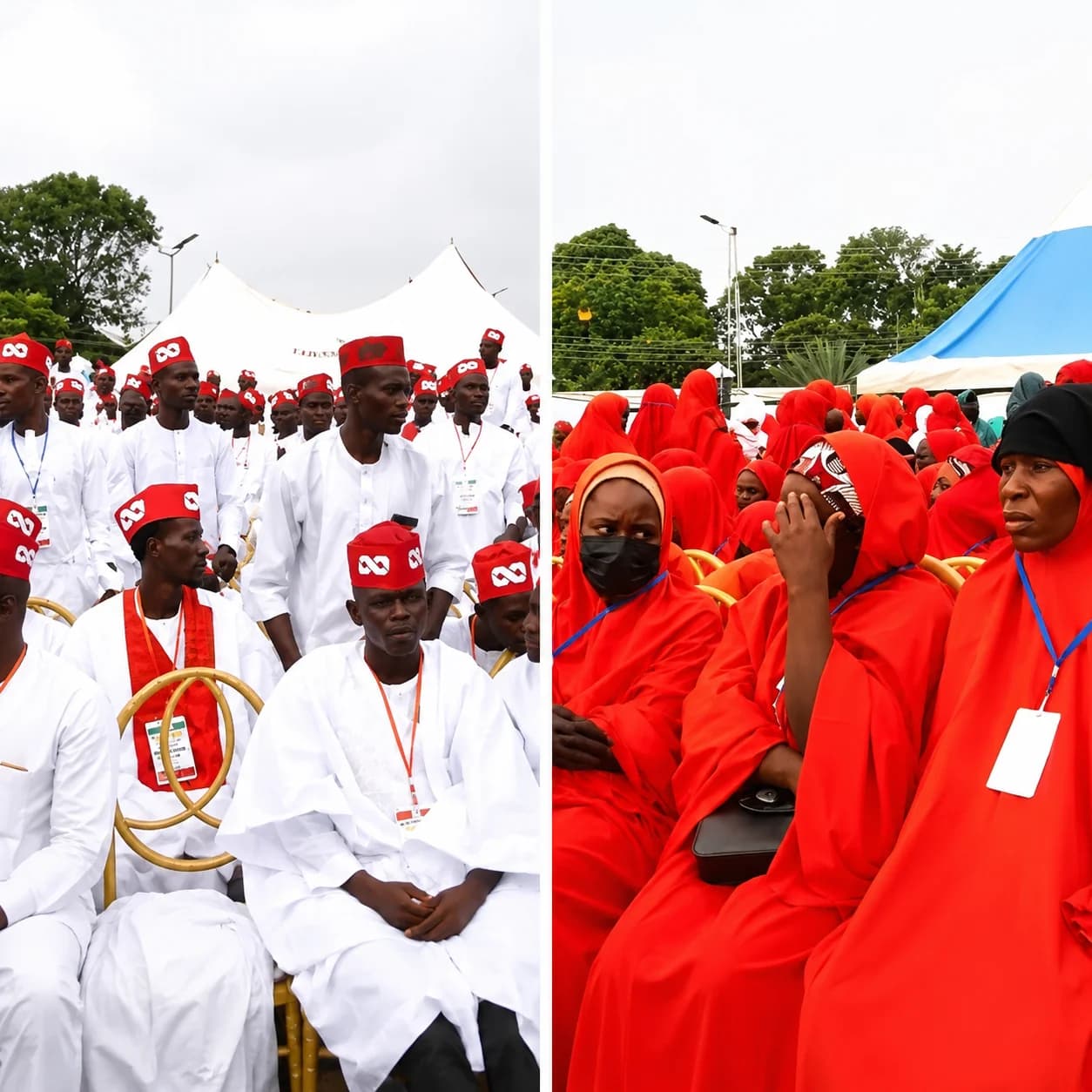
Kano State has once again placed its long-running mass-wedding programme at the centre of a national conversation after the government sponsored marriages for 1,500 couples, providing financial and material assistance to help the newlyweds begin their lives together.
The programme, organised under the state's Auren Gata initiative and coordinated through the Kano State Hisbah Board, was designed primarily to assist vulnerable residents who might otherwise struggle to meet the financial demands associated with marriage.
But while hundreds of couples celebrated their unions, the use of public funds for the programme has triggered a wider argument about poverty, government priorities and what social welfare should look like in today's Nigeria.
₦1.5 Billion for the Programme
The Kano State Government earmarked approximately ₦1.5 billion for the initiative.
Officials said the money covered a range of support for the beneficiaries, including furniture, food items, clothing materials, dowries and empowerment assistance.
Reports before the ceremony said each couple would receive a support package valued at roughly ₦1 million, while individual grants were also included in the package.
The intention was not simply to organise a wedding ceremony.
The government presented the initiative as a way of helping couples establish households after marriage.
More Than a Wedding Ceremony
For many of the beneficiaries, the attraction of the programme was the financial assistance attached to it.
Marriage can be expensive even before a couple begins paying rent, buying food or furnishing a home.
In Kano, where many young people face limited employment opportunities and rising living costs, those expenses can become a significant barrier to marriage.
The government therefore argues that removing some of those costs can help vulnerable people establish families without starting married life under overwhelming financial pressure.
The programme also included medical screening, with prospective participants undergoing tests including HIV, hepatitis, pregnancy and genotype compatibility.
The Programme Has a Long History
Kano's mass-wedding initiative is not new.
The programme has been organised under different administrations and has become a recurring feature of the state's social-welfare strategy.
The latest edition was described by officials as part of efforts to support low-income families, encourage marriage and strengthen family structures.
For supporters, its continuation demonstrates that the programme has become an established intervention rather than a one-off political gesture.
Nigerians Ask: Is ₦1.5 Billion Justified?
This is where the controversy begins.
Critics argue that Kano is one of Nigeria's poorest states and faces enormous challenges involving education, healthcare, unemployment, infrastructure and poverty.
They therefore question whether allocating ₦1.5 billion to marriage support represents the best possible use of scarce public resources.
The argument is not necessarily against helping poor couples.
Rather, critics ask whether the same money could have been invested in programmes that generate income for a much larger number of people.
That question has generated significant discussion around the programme.
"What Happens After the Wedding?"
Perhaps the strongest criticism is also the simplest:
What happens after the wedding?
Providing a bed, food, clothing and startup money can help a couple begin married life.
But marriage itself creates long-term financial responsibilities.
There will be rent.
There will be food.
There may be children.
There will be healthcare expenses and school fees.
And both partners may need sustainable sources of income.
That is why some Nigerians argue that the government should place even greater emphasis on employment, vocational training and small-business financing alongside marriage assistance.
Supporters See It Differently
Supporters of the programme argue that critics are overlooking its social purpose.
For a poor couple who cannot afford the basic cost of getting married, government assistance can make an enormous difference.
A bride receiving startup capital could potentially establish a small business.
A groom receiving assistance with dowry could avoid taking on debt.
Furniture and household items can also reduce the initial cost of establishing a home.
From that perspective, the programme is not simply paying for a wedding party.
It is helping vulnerable people establish households.
The Emotional Side of the Programme
The human stories behind the mass wedding have also changed the way some people view the initiative.
One of the most striking stories is that of Haruna Bashir, a Kano man who lost his wife and six children in an attack earlier in 2026.
He participated in the mass wedding as he began another chapter of his life.
His story has added an emotional dimension to the debate.
For people like Bashir, the programme represents more than government spending.
It can represent a chance to rebuild after devastating personal loss.
The Programme Is Also About Social Stability
Kano officials have repeatedly argued that supporting marriage can contribute to social stability.
The logic is straightforward.
If young people can establish families and gain economic support, they may be less vulnerable to some of the social pressures associated with unemployment, poverty and insecurity.
Whether mass weddings alone can achieve that objective is debatable.
But the underlying idea is that social welfare should not focus exclusively on infrastructure and cash transfers.
Family support can also form part of a wider social policy.
Medical Screening Adds Another Dimension
One aspect of the programme that has received less attention is the health screening.
Prospective couples were screened for conditions including HIV, hepatitis and genotype compatibility before being admitted to the programme.
The genotype component is particularly significant because officials have used the programme to encourage couples to understand their genetic compatibility before marriage.
That turns the initiative into something broader than a financial intervention.
It also incorporates elements of public-health education.
The Hisbah Board's Role Raises Questions Too
The involvement of the Kano State Hisbah Board has also attracted attention.
Hisbah officials have been responsible for coordinating important parts of the programme, including screening, counselling and marriage-related arrangements.
The board has also introduced guidelines concerning marital disputes, including a requirement that couples involve the Hisbah Board before pursuing divorce.
That aspect has prompted a separate discussion about how far a government-backed religious institution should be involved in the private lives of married couples.
Politics Is Inevitably Part of the Conversation
The programme is also taking place in a politically charged environment.
Governor Abba Kabir Yusuf has presented the initiative as part of his administration's social-welfare agenda.
Supporters are likely to view its successful implementation as evidence that the governor is fulfilling promises made to residents.
Critics, meanwhile, may interpret the spending through the lens of political priorities and ask whether government programmes should focus more heavily on economic empowerment.
In Nigerian politics, both interpretations can coexist.
A programme can genuinely help people while simultaneously becoming politically valuable to the administration that funded it.
The Bigger Economic Problem
Ultimately, the mass wedding debate exposes a much larger problem facing northern Nigeria.
Millions of people are struggling with the cost of establishing and maintaining households.
Young people face unemployment and underemployment.
Small businesses struggle with capital.
Food and housing costs remain difficult for many families.
Marriage support can address one part of that problem.
It cannot solve all of it.
What Would Make the Programme More Effective?
If the government wants the initiative to have lasting impact, the wedding itself may need to be only the beginning.
The couples could potentially benefit from follow-up programmes involving:
Vocational training
Small-business financing
Agricultural support
Employment placement
Financial-literacy programmes
Maternal and child healthcare
Housing assistance
Business mentorship
That would transform the programme from a wedding intervention into a longer-term family empowerment programme.
The Debate Should Not Become "Wedding vs Development"
There is a temptation to frame the issue as a simple choice:
Spend ₦1.5 billion on weddings or spend it on development.
But social welfare does not necessarily have to be that simplistic.
Governments spend money on programmes designed to support vulnerable groups for many different reasons.
The real question should be whether each programme is properly designed, transparent and capable of producing measurable benefits.
If the mass wedding helps thousands of people establish economically stable families, it can be defended as social investment.
If it simply provides a ceremony and short-term gifts without addressing the couples' long-term economic circumstances, critics will have a stronger argument.
Nigerians Are Watching What Comes Next
The wedding ceremony may have ended, but the real test has only begun.
In six months or one year, Nigerians will want to know whether the couples are actually doing better.
Are the businesses started with the empowerment grants still operating?
Are the families financially stable?
Are the couples able to afford food and housing?
Has the programme reduced the economic barriers that originally prevented them from marrying?
Those outcomes will ultimately determine whether the programme deserves to be considered a successful social intervention.
The Bottom Line
Kano State's government-backed mass wedding for 1,500 couples, supported by an allocation of about ₦1.5 billion, has produced both celebration and controversy.
For the beneficiaries, the programme provided more than a wedding ceremony. It offered household items, food, dowry assistance, empowerment support and medical screening designed to help couples begin married life.
For critics, however, the bigger question is whether such spending is justified in a state where poverty, unemployment and inadequate public services remain major challenges.
And perhaps that is the question that should dominate the conversation.
Helping people get married is one thing. Helping them build families that can survive economically is another.
If Kano can turn the ₦1.5 billion intervention into a pathway toward sustainable livelihoods for the 1,500 couples, the programme could become a genuine model of social welfare.
If not, Nigerians may continue asking why government money was spent helping people say "I do" when the harder question begins the following morning:
How do we survive together?
EDITORIAL TEAM
About Talk Ya True Editorial Team
The Talk Ya True Editorial Team is an independent newsroom committed to factual reporting, responsible journalism and thoughtful analysis across Africa and around the world.
Related Articles
Politics
Fayose's Unusual Take on Nigeria's Power Crisis Sparks Debate Over Birth Rates
Politics
Primate Ayodele Warns Tinubu: Nigeria's Hardship Could Become a Political Problem
Nigeria
308 Kidnap Victims Rescued in Nigeria's Largest Single-Day Rescue Operation
Politics
ADC Fires Back at Wike Over Amaechi Comments
Stay Informed
Get the biggest stories from Nigeria, Africa and around the world.
Free news updates. Unsubscribe anytime.
By subscribing, you agree to receive free news updates from Talk Ya True. You can unsubscribe at any time.